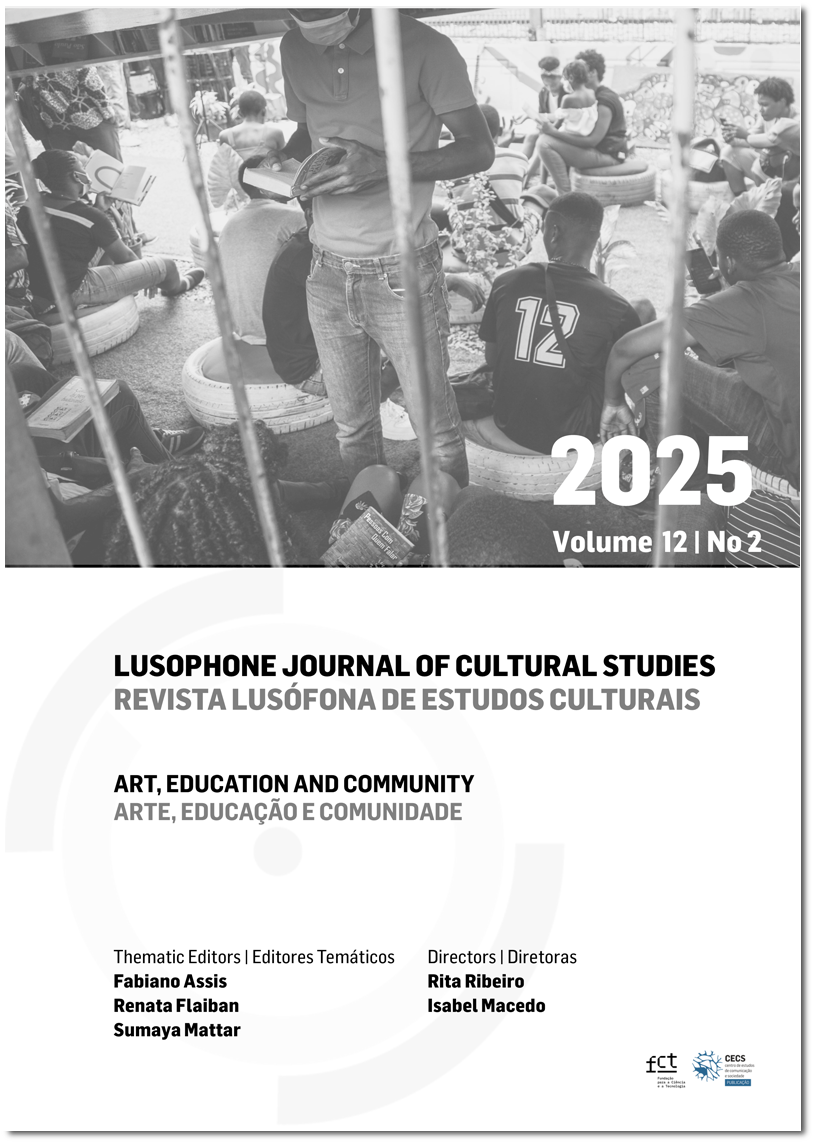
Art, Education, and Community
DOI:
https://doi.org/10.21814/rlec.7044Downloads
References
Bauman, Z. (2001). Modernidade líquida (P. Dentzien, Trad.). Zahar. (Trabalho original publicado em 2000)
Bhabha, H. K. (1994). The location of culture. Routledge.
Bispo dos Santos, A. (2018). Somos da terra. PISEAGRAMA, (12), p. 44–51.
Boal, A. (2009). A estética do oprimido. Garamond.
Bosi, E. (1994). Memória e sociedade: Lembranças de velhos (3.ª ed.). Companhia das Letras. (Trabalho original publicado em 1987)
Bosi, E. (2003). O tempo vivo da memória: Ensaios de psicologia social. Ateliê Editorial.
Bourdieu, P. (2021). O poder simbólico (F. Tomaz, Trad.). Edições 70. (Trabalho original publicado em 1982)
Butler, J. (2019). Vida precária – Os poderes do luto e da violência (A. Lieber, Trad.). Autêntica. (Trabalho original publicado em 2004)
Castells, M. (2011). A sociedade em rede. A era da informação: Economia, sociedade e cultura (Vol. 1, R. V. Majer, Trad.). Paz e Terra. (Trabalho original publicado em 1999)
Castro, E. V., & Danowski, D. (2023). Há mundo por vir? Antígona. (Trabalho original publicado em 2014)
Crenshaw, K. W. (1989). Demarginalizing the intersection of race and sex: A Black feminist critique of antidiscrimination doctrine, feminist theory and antiracist politics. University of Chicago Legal Forum, 1989(1), 139–167.
Cruz, H. (2021). Práticas artísticas. Participação e política. Edições Colibri.
Davis, A. (2016). Mulheres, raça e classe (H. R. Candiani, Trad.). Boitempo. (Trabalho original publicado em 1981)
Fanon, F. (2015). Os condenados da terra (A. Massano, Trad.) Letra Livre. (Trabalho original publicado em 1961)
Fanon, F. (2017). Pele negra, máscaras brancas (A. Pomar, Trad.) Letra Livre. (Trabalho original publicado em 1952)
Foucault, M. (1999). Vigiar e punir (20.ª ed., R. Ramalhete, Trad.). Vozes. (Trabalho original publicado em 1975)
Freire, P. (2019). Pedagogia do oprimido (84.ª ed.). Paz e Terra. (Trabalho original publicado em 1968)
Freire, P. (2020). Pedagogia da esperança: Um reencontro com a pedagogia do oprimido (32.ª ed.). Paz e Terra. (Trabalho original publicado em 1992)
Gonzalez, L. (1988). A categoria político-cultural de amefricanidade. Tempo Brasileiro, (92/93), 69–82.
Halbwachs, M. (2006). A memória coletiva (2.ª ed., B. Sidou, Trad.). Centauro. (Trabalho original publicado em 1950).
Hall, S. (2000). Quem precisa da identidade? In T. T. Silva (Ed.), Identidade e diferença. A perspectiva dos estudos culturais (pp. 103–133). Vozes.
Hall, S. (2003). Da diáspora: Identidades e mediações culturais (L. R. Sovik, Ed.; A. L. G. Resende, A. C. Escosteguy, C. Alvares, F. Rudiger, & S. Amaral, Trads.). UFMG/Unesco.
Haraway, D. (2016). Antropoceno, capitaloceno, plantationoceno, chthuluceno: Fazendo parentes. ClimaCom Cultura Científica, 3(5), 139–146.
hooks, b. (2013). Ensinando a transgredir: A educação como prática da liberdade (M. B. Cipolla, Trad.). Wmf Martins Fontes. (Trabalho original publicado em 1994)
hooks, b. (2021). Ensinando comunidade: Uma pedagogia da esperança (K. Cardoso, Trad.). Elefante. (Trabalho original publicado em 2003)
Krenak, A. (2020). A vida não é útil: Ideias para salvar a humanidade. Companhia das Letras.
Latour, B. (2014). Para distinguir amigos e inimigos no tempo do antropoceno. Revista de Antropologia, 57(1), 11–31. https://doi.org/10.11606/2179-0892.ra.2014.87702
Lipovetsky, G., & Serroy, J. (2010). A cultura-mundo. Resposta a uma sociedade desorientada (V. Silva, Trad.). Edições 70. (Trabalho original publicado em 2008)
Maffesoli, M. (1984). A conquista do presente (A. C. M. Stuckenbuck, Trad.). Rocco. (Trabalho original publicado em 1979)
Maffesoli, M. (2010). Saturação (A. Goldberger, Trad.). Iluminuras. (Trabalho original publicado em 1996)
Martins, M. L. (2011). Crise no castelo da cultura. Das estrelas para os ecrãs. Grácio. http://hdl.handle.net/1822/29167
Mbembe, A. (2011). Necropolítica (E. F. Archambault, Trad.). Editorial Melusina.
Mignolo, W. D. (2019). A colonialidade está longe de ter sido superada, logo, a decolonialidade deve prosseguir. In A. Carneiro (Ed.), Arte e descolonização. MASP/Afterall.
Quijano, A. (2005). Colonialidade do poder, eurocentrismo e América Latina. In E. Lander (Ed.), A colonialidade do saber: Eurocentrismo e ciências sociais (pp. 117–142). Clacso.
Ryngaert, P. (1981). O jogo dramático no meio escolar (C. Zurbach & M. Guerra, Trads.). Centelha. (Trabalho original publicado em 1977)
Sousa, A. B. (2003). Educação pela arte e artes na educação (Vol. 1). Instituto Piaget.
Sousa, J. M. B. F. (2012). Aqui é o mundo. Teatro e técnicas de expressão [Tese de doutoramento, Universidade do Minho]. RepositóriUM. http://hdl.handle.net/1822/25423
Souza, J. (2021). Como o racismo criou o Brasil. Estação Brasil.
Spivak, G. C. (2010). Pode o subalterno falar? (S. R. G. Almeida, M. P. Feitosa, & A. P. Feitosa, Trads.). UFMG. (Trabalho original publicado em 2009)
Spolin, V. (2010). Improvisação para o teatro (I. D. Koudela & E. J. A. Amos, Trads.). Perspectiva. (Trabalho original publicado em 1963)
Stiegler, B. (2018). Da miséria simbólica I. A era hiperindustrial (L. Lima, Trad.). Orfeu Negro. (Trabalho original publicado em 2004)
Comissão Executiva do Plano Nacional das Artes. (2019). Plano Nacional das Artes – Uma estratégia, um manifesto, 2019–2024. Ministério da Cultura/Ministério da Educação.
Walsh, C. (2009). Interculturalidad, estado, sociedad: Luchas (de)coloniales de nuestra época. Universidad Andina Simón Bolívar/Abya Yala.
Williams, R. (2011). Cultura e materialismo (A. Glaser, Trad.). Editora Unesp. (Trabalho original publicado em 1980)
Williams, R. (2015). Recursos da esperança: Cultura, democracia, socialismo (N. Fonseca & J. A. Peschanski, Trads.). Editora Unesp. (Trabalho original publicado em 1987)
Xakriabá, C. (2020). Amansar o giz. PISEAGRAMA, (14), p. 110–117.
Downloads
Published
How to Cite
Issue
Section
License
Copyright (c) 2025 Fabiano Assis da Silva, Renata Flaiban, Sumaya Mattar

This work is licensed under a Creative Commons Attribution 4.0 International License.
Authors own the copyright, providing the journal with the right of first publication. The work is licensed under a Creative Commons - Atribuição 4.0 Internacional License.